


.svg)
For decades, a beautiful shower meant one thing: tile, and a lot of grout lines. That's changing. High-end bathrooms are increasingly moving away from the traditional grid of tile toward seamless, full-height porcelain slab panels that cover an entire wall in a single sheet. The result is a very different look and a very different maintenance reality.
Both approaches can produce a stunning, durable shower. But they're built differently, they cost differently, and they behave differently over a lifetime of use. Custom tile offers almost endless design texture and versatility. Porcelain slabs offer unbroken visual continuity and near-zero maintenance. This guide breaks down the real technical and aesthetic differences, so you can choose the right one for your bathroom rather than the one that photographed well on someone else's.
Porcelain Slab Showers: Unbroken, Seamless Luxury
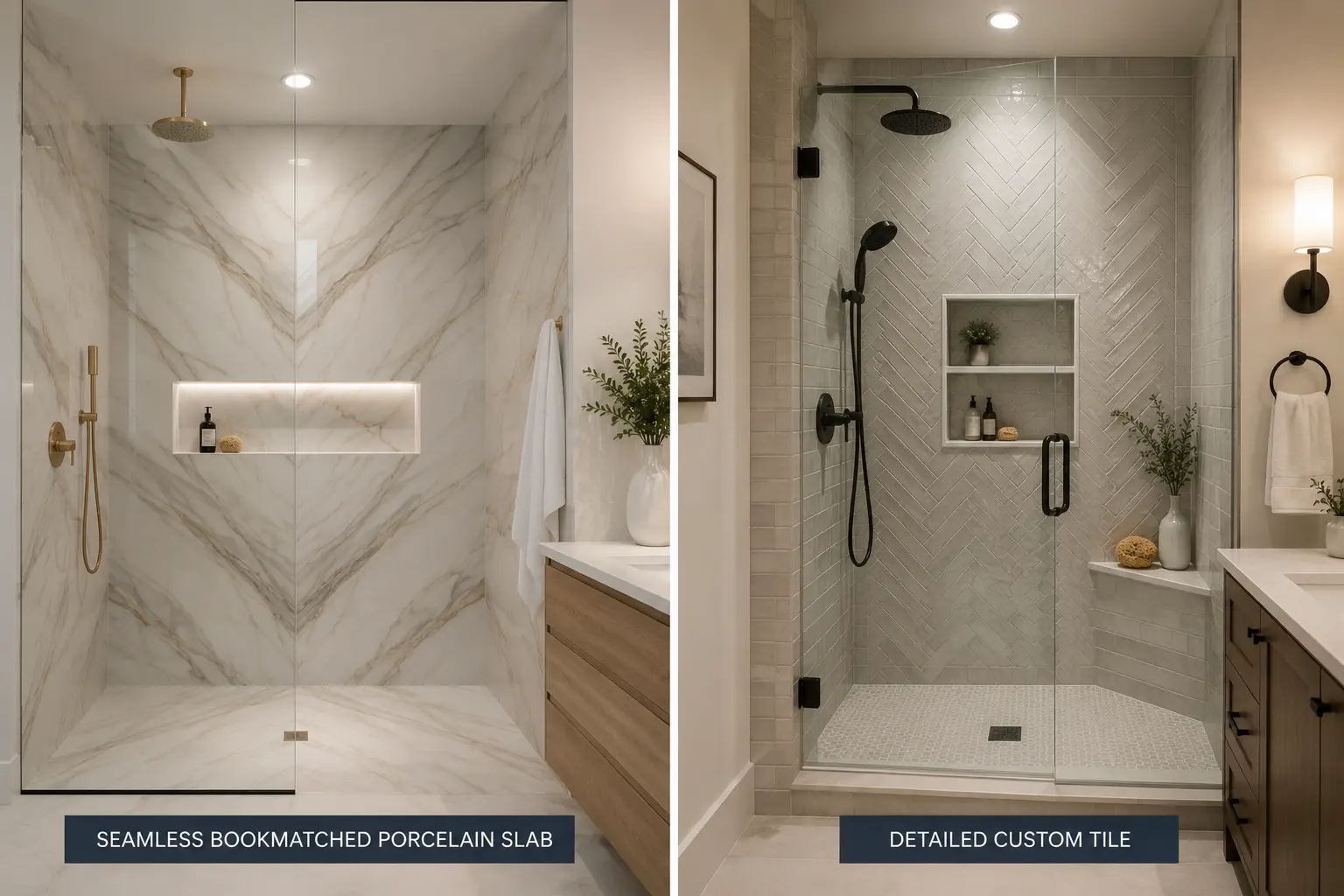
A porcelain slab shower uses large gauged porcelain panels, typically 6mm to 12mm thick and manufactured in massive sheets up to 5 feet by 10 feet or larger, to cover an entire shower wall with a single piece. Where tile creates a grid, a slab creates a continuous, uninterrupted surface. That's the whole appeal.
The advantages are significant, and they're why slabs have become the signature of contemporary luxury baths. The biggest is the near-total elimination of grout: a slab wall has only a handful of panel seams instead of hundreds of linear feet of grout, which removes the vast majority of the surface where mold, mildew, and scrubbing live. Slabs also allow continuous bookmatching, letting the veining of a marble-look or natural stone pattern mirror seamlessly across adjoining walls for a dramatic, gallery-like effect. And because the surface is non-porous, it's essentially impervious to water, staining, and soap scum buildup.
The drawbacks are mostly about installation and logistics, not the finished product. Slabs demand specialized installation by certified crews using suction-cup handling frames, diamond cutting rigs, and sometimes hoist or crane rigging to move panels through tight interior spaces. Material and freight costs run high, since panels must be crated and carry real breakage risk in transit. And the structural requirements are strict: the wall framing has to be perfectly plumb and rigid, meeting a deflection limit of L/720, or the panels can crack. This is not a forgiving material, which is exactly why the framing and substrate work matters as much as the slab itself.
Custom Tile Showers: Timeless Craftsmanship and Flexibility
A custom tile shower is built from individual ceramic, porcelain, glass, or natural stone tiles set one at a time with thin-set mortar and sealed grout lines. It's the traditional approach, and its strength is total design freedom. If you can draw it, a skilled tile setter can usually build it.
That flexibility is the headline advantage. Custom tile gives you complete creative range: herringbone, chevron, mosaic, classic subway, custom borders, and combinations that a single slab simply can't produce. It also conforms to complex architecture in a way slabs can't, wrapping built-in benches, arched openings, sloped ceilings, and recessed niches cleanly. And tile is far more repairable: a cracked tile can be swapped out individually, while a damaged slab often means tearing out an entire wall.
The tradeoffs come down to grout and time. Cementitious grout needs periodic sealing and deep cleaning to stay looking right, and while epoxy grout resists staining better, it adds labor and cost to install. Tile is also slow to set well: placing hundreds of individual pieces with leveling clips and consistent spacing is prolonged, skilled, on-site work. You're paying for craftsmanship and hours, and the quality of the installer shows in the result more than with almost any other finish.
Porcelain Slab vs. Custom Tile: Head-to-Head
When you line the two up across the metrics that matter, porcelain slabs win on seamlessness and maintenance while custom tile wins on design flexibility and repairability. Here's the direct comparison.
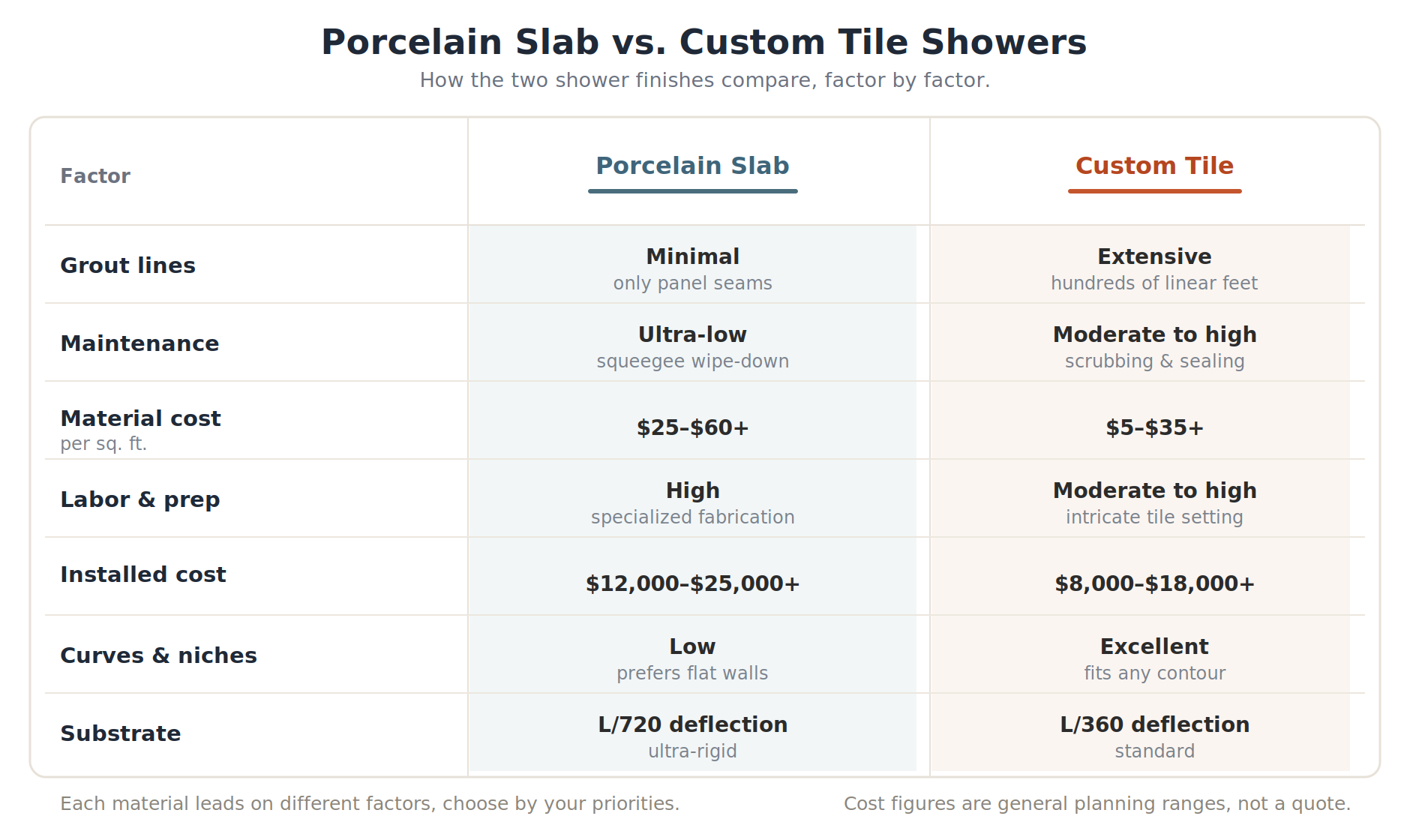
The pattern is clear. Slabs are the choice for a clean, modern, low-maintenance surface on straight walls, and tile is the choice for intricate, contoured, or highly customized designs at a more flexible price point.
The Structural and Installation Details That Actually Matter
The finish you see is only as good as the substrate you don't, and this is where porcelain slabs and custom tile diverge most. Both live or die on the prep work behind them.
Substrate preparation is the first divide. Slabs demand a perfectly flat, rigid base, cement backer board or an uncoupling membrane over framing that is dead-plumb, because out-of-plumb studs create panel stress that leads to cracking. Tile is more forgiving: a skilled setter can absorb slight wall imperfections through mortar bed adjustments as the tiles go up. This difference is also codified in deflection standards. The Tile Council of North America sets the widely used benchmarks, and its tile installation standards call for a stiffer L/720 subfloor and wall assembly for stone and large-format work versus the standard L/360 for typical tile. Ignoring that spec is how expensive failures happen.
Waterproofing is the second, and it's non-negotiable under either material. Neither slab nor tile is the waterproofing layer. An integrated waterproofing membrane, such as a Schluter-KERDI or Hydro Ban system, sits beneath the finish and protects the framing from the water that inevitably passes the surface. A gorgeous slab or a flawless tile job over failed waterproofing is a leak waiting to happen, which is why the membrane detailing at the pan, the curb, and every penetration matters more than the finish on top.
On-site logistics are the third factor, and they're easy to underestimate with slabs. Maneuvering a full-size panel of 60 inches by 120 inches through residential hallways, doorways, and stairwells is a genuine engineering challenge, one that boxed cases of tile never pose. On some jobs, the question isn't whether a slab will look good, but whether it can physically reach the bathroom intact.
Which Adds More Resale Value?
Porcelain slabs tend to make a stronger immediate impression on buyers, delivering that five-star luxury hotel look that commands attention the moment someone walks in. Their seamless, grout-free surfaces read as high-end and low-maintenance, both of which resonate with today's buyers.
Longevity favors porcelain as well. Porcelain panels can last a lifetime without fading or etching, whereas natural stone tile requires ongoing resealing to stay protected, and ceramic tile can show glaze wear in high-use areas over time. That said, a beautifully executed custom tile shower carries its own timeless appeal, especially in traditional or character homes where a seamless modern slab might feel out of place. The strongest resale move is matching the finish to the home and doing it flawlessly, because a poorly installed version of either material reads as a liability, not a feature.
Which Should You Choose?
The right choice comes down to your priorities on maintenance, design complexity, and budget. Here's the short version.
Choose porcelain slabs if grout-free, low-maintenance living is your top priority, if you're building a modern, minimalist, or luxury contemporary bath, and if your budget accounts for specialized fabrication and freight. On flat, straight walls, nothing else looks quite like a continuous slab.
Choose custom tile if you love traditional, organic, textured, or historical aesthetics, if your shower design includes complex curves, multiple benches, or custom slope cuts, and if you want more flexibility to balance material and labor costs. For intricate, contoured designs, tile isn't just the better option, it's often the only one.
For many high-end baths, the answer is both: slab on the feature walls for that seamless impact, custom tile on the floor and in the niches where contour and grip matter. A good builder will tell you where each material earns its place.
Precision Shower Engineering by Brutsky Builds
Whether you're planning a continuous porcelain slab sanctuary or a custom hand-tiled walk-in shower, the finish is only half the job. Structural accuracy, a properly rigid substrate, and flawless waterproofing are what separate a shower that lasts decades from one that fails in a few years, and none of that is visible once the walls are up. It has to be right the first time.
Brutsky Builds is a licensed, insured, and bonded general contractor (license #BRUTSBL783ON) and a member of the National Association of Home Builders, serving Seattle and the greater Eastside. We engineer and build both porcelain slab and custom tile showers to the standards each material demands, and every bathroom is backed by a one-year installation warranty. Explore our custom bathroom remodels or see how scope maps to budget on our bathroom pricing page. Call (206) 316-9937 or schedule a design consultation to plan your shower.


.svg)
.svg%20fill.svg)


.webp)
.webp)
.webp)

.svg)