


.svg)
Almost every primary bathroom remodel hits the same fork in the road. You've got a fixed amount of floor space, and you have to decide: a big, luxurious walk-in shower, or a statement soaking tub? In a smaller primary bath, you often can't have both, and the choice you make shapes how the room looks, how you use it every day, and what it does for your home's value down the line.
This is one of the most common decisions we help homeowners work through, and the right answer depends on more than personal taste. It comes down to resale ROI, how you actually live, the square footage you're working with, and one resale rule that trips up a lot of people. Here's how to think it through.
The Walk-In Shower: High Functionality and Modern Luxury
A walk-in shower is the most practical and broadly appealing centerpiece for a modern primary bath, which is exactly why demand for them keeps climbing. It combines everyday convenience with a clean, open, contemporary look that reads as high-end to almost any buyer.
Homeowners gravitate to walk-in showers for a few clear reasons. They're fast and convenient for daily use. Frameless glass and a curbless, zero-threshold entry make the whole room feel larger and more open. And that same curbless design carries a major aging-in-place benefit: a step-free shower supports universal design, letting a home work for its owners across decades and mobility levels, a priority the National Association of Home Builders tracks closely in its research on what home buyers really want.
The features that turn a basic shower into a value-adding one are worth budgeting for. Built-in benches and recessed niches add function without clutter. Linear drains allow for large-format tile and cleaner sightlines. Dual showerheads, rainfall sprayers, and digital or steam shower systems deliver the spa experience, and floor-to-ceiling porcelain slab or custom tilework gives the room its wow factor. Done well, a walk-in shower is the low-maintenance, everyday luxury that a large majority of today's primary-suite buyers actively look for.
The Soaking Tub: Architectural Impact and Spa Appeal
A soaking tub is a statement piece, delivering architectural drama and a genuine spa experience that a shower can't replicate. Where a shower is about function, a freestanding tub is about feeling, and in the right home it becomes the visual anchor the whole bathroom is designed around.
The appeal is emotional and aesthetic. A freestanding tub creates an instant focal point, and for anyone who genuinely loves a long soak, it's the ultimate relaxation feature, a private retreat at the end of the day. The high-end versions lean into that: sculptural freestanding tubs in acrylic, resin, or cast iron; floor-mounted high-flow tub fillers; and upgrades like integrated air jets or heated backrests that push the experience toward true hydrotherapy.
The honest tradeoff is frequency of use. Soaking tubs are highly desirable in upper-tier luxury markets and photograph beautifully, but most people use them far less often than a shower, weekly or monthly rather than daily. That gap between desire and daily use is central to the value question, and it's why the tub is best understood as a luxury addition rather than a like-for-like replacement for a shower.
Walk-In Shower vs. Soaking Tub: Head-to-Head
When you put the two side by side across the factors that actually drive value, the walk-in shower wins on breadth of appeal and daily utility, while the soaking tub wins on luxury statement and relaxation. Here's the direct comparison.
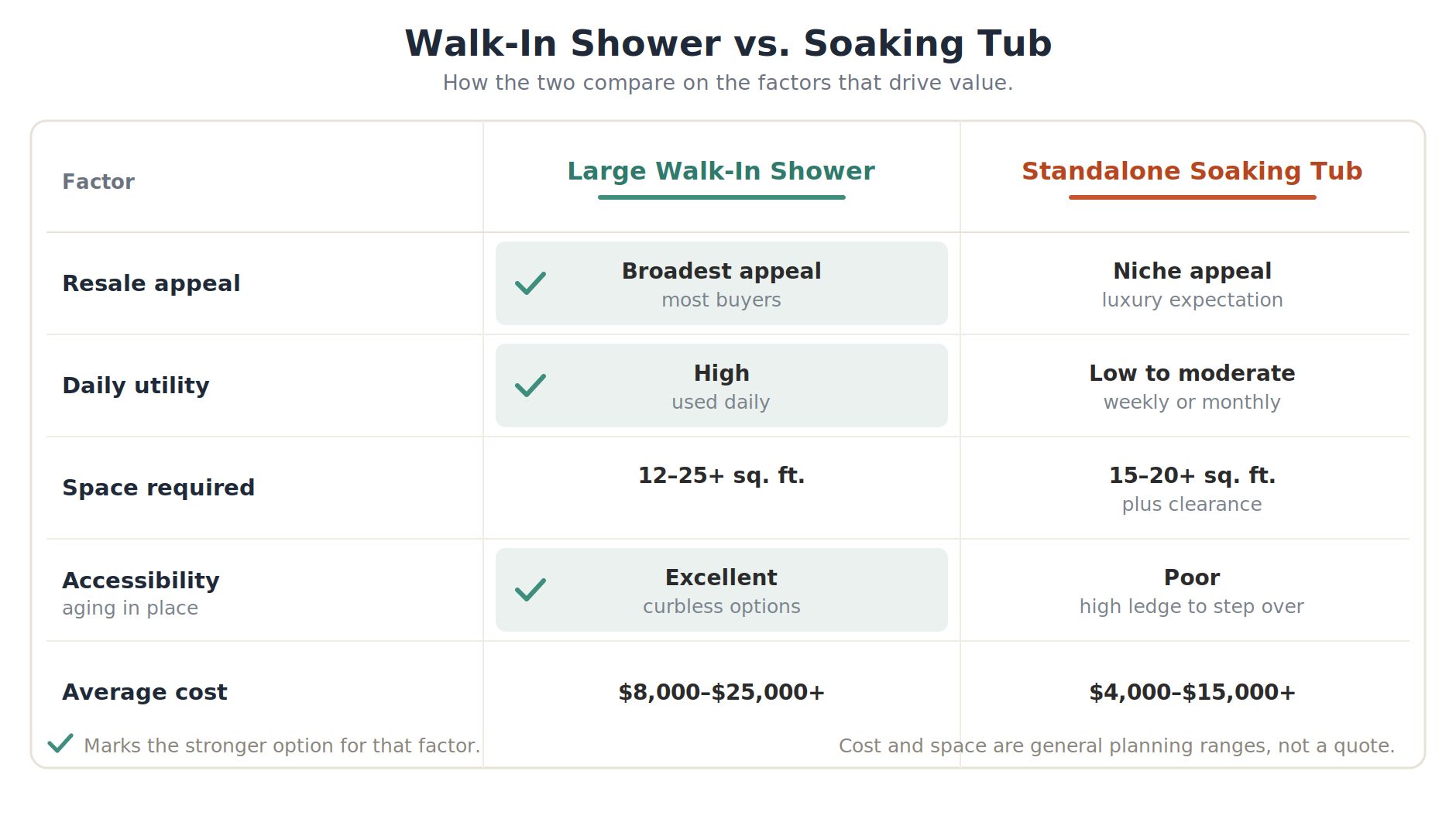
The pattern is clear. If you're optimizing purely for resale value and everyday use, the walk-in shower is the stronger, safer bet for most homes. The soaking tub earns its place when you have the space and the lifestyle to justify it, or when a luxury market expects one.
Will Removing Your Only Tub Hurt Resale Value?
Yes, removing the only bathtub in your entire home can hurt resale value, and this is the single most important rule to understand before you commit to a shower-only primary bath. Real estate agents call it the one-tub rule, and it exists because a specific and sizable group of buyers needs a tub: families with young children and pet owners who simply cannot bathe a toddler or a dog in a curbless shower.
Lose every tub in the house, and you quietly remove your home from consideration for many of those buyers. That's a real cost at resale, even if you personally never take a bath.
There are two situations where ditching the tub in your primary bath is perfectly safe. First, if another bathroom in the home already has a tub or a tub-shower combo, your house still checks the box, and a shower-only primary suite becomes a feature rather than a liability. Second, if you plan to stay in the home long-term, say ten years or more, and you value custom, everyday utility over immediate buyer appeal, building for how you live is a reasonable call. Just make the decision with eyes open.
The Best of Both Worlds: The Wet Room Solution
A wet room solves the shower-versus-tub debate by enclosing both a freestanding soaking tub and a walk-in shower behind a single pane of glass. It's the layout homeowners increasingly ask for when they refuse to choose, and it delivers a high-end, resort-style feel that neither fixture achieves alone.
The advantages are real. A wet room uses space efficiently by combining the two wet zones into one waterproofed enclosure, it creates a striking spa retreat, and it eliminates the compromise entirely. You keep the tub for resale and relaxation and the shower for daily use.
The tradeoffs are budget and square footage. A wet room demands extensive, meticulous waterproofing across the whole enclosure, a larger footprint, and a higher overall investment. It's a premium solution, and it belongs in a bathroom with the room to support it. As a rough guide, a primary bath of around 150 square feet or more gives you the footprint to do it well.
Cost and Structural Factors to Consider
Beyond the fixtures themselves, three behind-the-wall factors can significantly change your budget, and skipping them is how a bathroom remodel blows past its estimate. Plan for them from the start.
Plumbing relocation is the first. Moving drain lines or supply lines to accommodate a new shower footprint or a freestanding tub in a new spot adds labor and, often, permitting. Keeping fixtures near their existing rough-in locations keeps costs down.
Weight is the second, and it's easy to overlook. A heavy stone or cast-iron soaking tub, filled with water and a person, is a serious load. Some installations require floor joist reinforcement to carry it safely, particularly on upper floors. This is a structural question, not a decorating one, and it needs to be answered before the tub is ordered.
Water heater capacity is the third. A large soaking tub or a multi-head shower system can outrun a standard water heater fast, turning your luxury feature into a lukewarm disappointment. Many of these projects call for an upgraded tankless or high-capacity water heater sized to the new demand.
Which One Should You Build?
The best choice comes down to matching the fixture to your space, your routine, and your resale timeline. Here's the short version.
Choose a walk-in shower if you prioritize daily convenience, accessibility, and a modern, open look, or if space is limited and you want the room to feel bright and larger than it is. For the majority of homeowners, this is the value-smart pick.
Choose a soaking tub if you already have a spacious shower and room to spare, and if hydrotherapy and relaxing baths are a genuine part of your routine rather than an aspiration. Just confirm there's another tub in the home for resale.
Choose both, or a wet room, if you have the footprint, roughly 150 square feet or more in the primary bath, and you want a true spa retreat that satisfies both daily use and long-term resale.
Ready to Redesign Your Primary Bathroom?
Whether you're envisioning a frameless walk-in steam shower, a sleek freestanding tub enclosure, or a full wet room that gives you both, the details are what separate a bathroom that looks luxurious from one that also lasts and adds value. Brutsky Builds handles every part of that process, from structural design and joist reinforcement to plumbing, waterproofing, and custom tile installation.
Brutsky Builds is a licensed, insured, and bonded general contractor (license #BRUTSBL783ON) and a member of the National Association of Home Builders, serving Seattle and the greater Eastside. Every bathroom we build is backed by a one-year installation warranty. Explore our custom bathroom remodels or see how scope maps to budget on our bathroom pricing page. Call (206) 316-9937 or schedule a design consultation to plan your primary bath.


.svg)
.svg%20fill.svg)


.webp)
.webp)
.webp)

.svg)