



.svg)
Walk into any kitchen showroom and you'll hear "apron sink" and "farmhouse sink" used as if they mean exactly the same thing. Most of the time, nobody corrects it. But there is a real difference between the two terms, and understanding it helps you choose the right sink for your kitchen's style, pick the right material, and, just as importantly, plan for the custom cabinet and plumbing work that both actually require.
Here's the short version, with the full explanation below: one term describes how the sink is built, and the other describes how it looks. Getting the distinction right is the first step, and knowing what these sinks demand behind the cabinet doors is what keeps your remodel on schedule. Let's clear it up.
What's the Difference Between an Apron Sink and a Farmhouse Sink?
The difference is that "apron-front" refers to the sink's construction while "farmhouse" refers to its style. An apron-front sink is any sink with an exposed front panel that sits forward, replacing the cabinet's top rail, whereas a farmhouse sink is the traditional, heritage-inspired look most often made from thick fireclay or enameled cast iron.
That's why the relationship runs one way: every farmhouse sink is apron-front by design, but a sleek stainless steel or quartz composite apron sink in a modern kitchen is not a farmhouse sink. Once you see the terms as one describing form and the other describing fashion, the choice gets much clearer, and so do the six practical differences that follow.
1. Architectural Feature vs. Visual Aesthetic
The most fundamental difference is that apron-front is a physical construction and farmhouse is a design style. An apron-front sink has its front wall built forward, exposed flush with or slightly proud of the adjacent cabinet doors, while "farmhouse" describes the rustic, heritage look that originated in 19th-century homesteads.
Understanding this frees you from thinking these sinks only belong in country kitchens. An apron-front sink in stainless or stone looks right at home in a modern, industrial, or transitional kitchen. Because the apron replaces the cabinet's top face rail, the cabinet shop drawings have to account for the exact sink cutout dimensions and the manufacturer's tolerances during design, which is why the sink decision comes before the cabinet order.
2. Material Variety: Traditional Fireclay vs. Modern Metals
Farmhouse and modern apron sinks diverge sharply on materials. Classic farmhouse sinks are almost always thick fireclay, porcelain, or enameled cast iron, while modern apron-front sinks expand into stainless steel, copper, quartz composite, and even natural soapstone.
That range is what lets the apron-front form suit any kitchen. Stainless or composite offers a sleek, low-maintenance surface for a contemporary space, while fireclay delivers the authentic, high-gloss centerpiece a traditional kitchen wants. There's a trade wrinkle worth knowing: fireclay sinks expand and warp slightly during kiln firing, so each unit is subtly unique, which means the installation relies on on-site scribing to the actual sink rather than a strict template cutout.
3. A Dedicated Sink-Base Cabinet
Both styles require a dedicated apron-front sink base cabinet, not a standard one. Neither an apron nor a farmhouse sink can simply drop into an ordinary 36-inch sink base, because the exposed apron needs shortened cabinet doors and a lowered top rail to seat properly.
This is where remodels go sideways when it's missed. Ordering standard cabinetry without specifying an apron-front sink base leads to expensive field modifications or delayed cabinet re-orders. Done correctly, the cabinet face frame is precision-trimmed and scribed around the sink apron for a tight, gap-free fit before the countertops are ever measured.
4. Heavy-Duty In-Cabinet Support Framing
Heavy farmhouse sinks require structural support built into the cabinet, independent of the countertop. A fireclay or cast-iron sink filled with water and dishes can weigh well over 200 pounds, far more than countertop clips or thin cabinet sides can safely hold.
Relying on inadequate support is how you end up with a failed cabinet, a cracked countertop, or leaks around the seals down the road. The correct approach is for finish carpenters to build an internal timber cradle, typically framed from 2x4 or 2x6 lumber, directly inside the cabinet base and leveled perfectly to carry the sink's full weight from underneath. Lighter stainless apron sinks need less, but the heavy classics are non-negotiable here.
5. Lowered Drain Line Rough-In
Deep apron and farmhouse basins require the drain to be roughed in lower than for a standard sink. These sinks feature deep single or double basins, often 9 to 10 inches or more, that sit significantly lower in the cabinet cavity than a typical undermount.
If the drain isn't adjusted for that depth, you get slow drainage or standing water in the garbage disposal, a common and frustrating result of overlooking it. The fix has to happen early: the plumber lowers the sanitary tee wall drain outlet, generally to around 12 to 14 inches above the finished floor, during the plumbing rough-in stage before the drywall is closed. Retrofitting it later means opening the wall.
6. Countertop Overhang and Sealant Detail
The countertop-to-sink transition, called the reveal, has to be detailed precisely to protect the installation. Countertops can be fabricated with a flush reveal, a positive reveal that exposes the sink rim, or a negative reveal where the stone overhangs the basin, and the choice affects both looks and longevity.
A precise reveal keeps standing water from pooling on the sink rim, which protects the silicone seal from mold and water damage over time. Achieving it takes care at fabrication: the stone is templated directly off the installed, leveled sink to guarantee clean, consistent reveals, usually around an eighth of an inch, and tidy silicone joints. This is a detail cheap installs skip and quality ones obsess over.
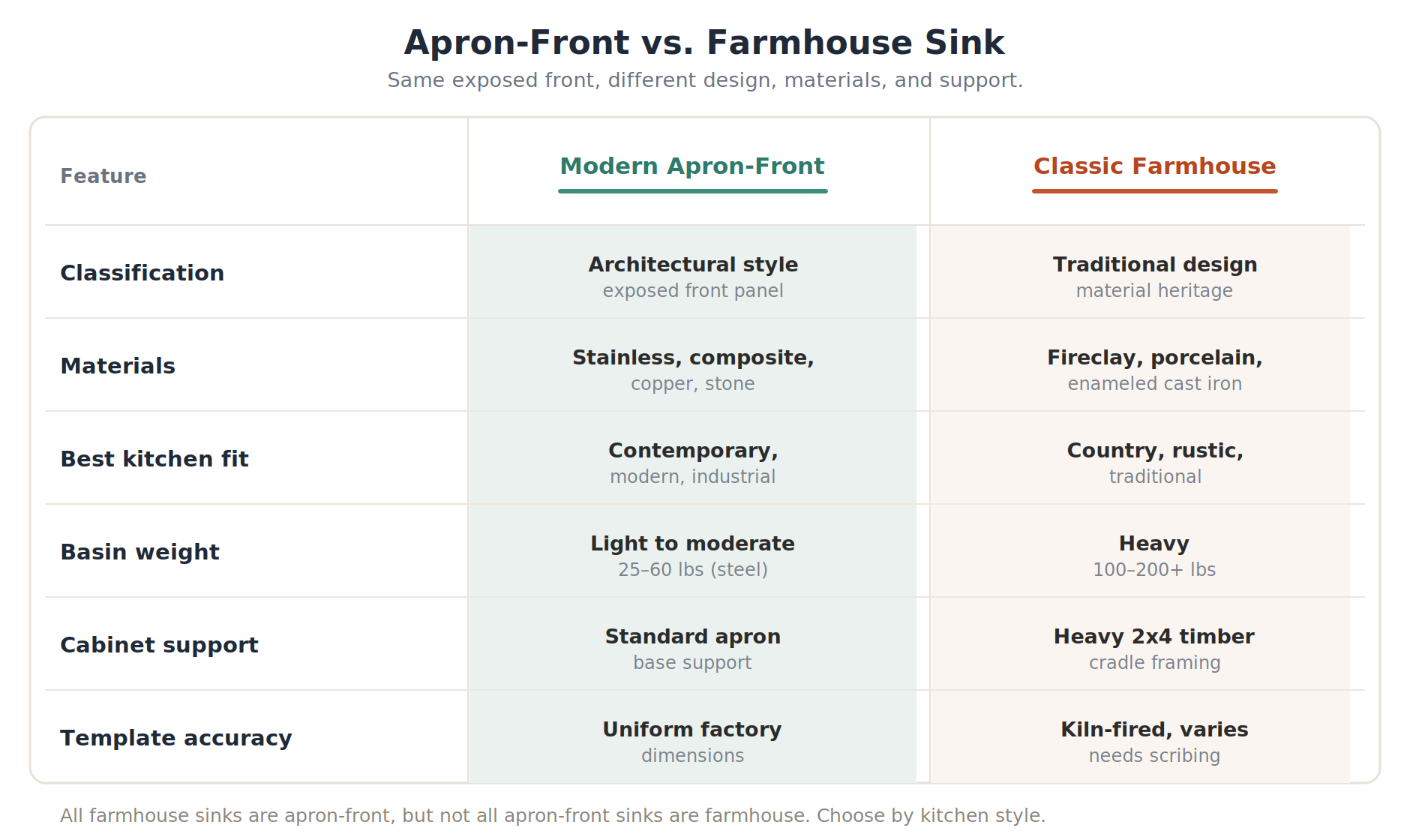
Apron-Front vs. Farmhouse Sink: Feature Comparison
Here's how the modern apron-front sink and the classic farmhouse sink compare across the specifications that matter most.
Which Sink Is Right for Your Kitchen?
The right sink comes down to your kitchen's style and how much custom support the material demands. If you're building a contemporary, modern, or industrial kitchen, a stainless, composite, or stone apron-front sink gives you that clean exposed-front look with lighter weight and uniform dimensions. If you want a classic, warm, heritage centerpiece for a country or transitional kitchen, a fireclay or cast-iron farmhouse sink is the authentic choice, as long as you plan for the cradle framing and scribing it requires.
Either way, the sink is one of the few kitchen decisions that has to be made early, because the cabinet base, the support framing, the plumbing rough-in, and the countertop template all depend on the exact unit you choose. The National Kitchen and Bath Association treats sink selection as an early planning decision for exactly this reason. Pick the sink first, and everything downstream fits it cleanly.
Pre-Purchase and Remodel Checklist
Before your cabinets are ordered, work through these with your design-build team:
- Select the exact sink unit before finalizing your kitchen cabinet shop drawings.
- Verify that your cabinet package includes a dedicated apron-front sink base cabinet.
- Confirm your contractor includes internal 2x4 timber support framing for a heavy sink.
- Review plumbing rough-in heights with your plumber so the wall drain sits low enough for a deep basin and disposal.
- Have the physical sink on-site during cabinet installation and countertop templating.
Upgrade Your Kitchen with Custom Trade Precision
Whether you choose a sleek modern apron-front sink or a classic fireclay farmhouse centerpiece, the beautiful part is only half the job. Exact cabinet scribing, structural support framing, and precise plumbing rough-in are what make either sink install cleanly and last, and all of it has to be planned before the cabinets are built.
Brutsky Builds is a Bellevue-based, licensed, insured, and bonded design-build general contractor (license #BRUTSBL783ON) serving Seattle and the greater Eastside. We handle the custom millwork, support framing, and finish plumbing that apron and farmhouse sinks depend on, backed by a one-year installation warranty. Explore our custom kitchen remodels or see how scope maps to budget on our kitchen pricing page. Call (206) 316-9937 to start planning your kitchen.


.svg)
.svg%20fill.svg)


.webp)
.webp)
.webp)

.svg)