



.svg)
.jpg)
Our recommendation is unambiguous, without hedging. For the substantial majority of Seattle-area kitchens we have remodeled recently, we recommend a square edge or a light eased edge, somewhere in the 1/16 inch to 1/4 inch round-over range depending on how soft you want the resulting line, over the more elaborate countertop edge profiles such as bullnose, ogee, or waterfall. This is not a compromise selection. It represents a clean, architectural aesthetic that allows a beautiful slab to remain the visual centerpiece, it will not read as dated the way a heavier profile can within a decade, and it happens to cost considerably less along the way.
That recommendation derives directly from what we consistently observe across active job sites. Across our recent Seattle-area projects, homeowners gravitate toward exactly this pairing, square corners or some dimension of round-over, considerably more often than the fancier profiles that dominate stone yard catalogs and countertop showroom presentations. We interpret that trend as sound judgment rather than a deficiency of imagination, and this article explains the reasoning behind our position.
What Counts as an Eased Edge, Exactly?
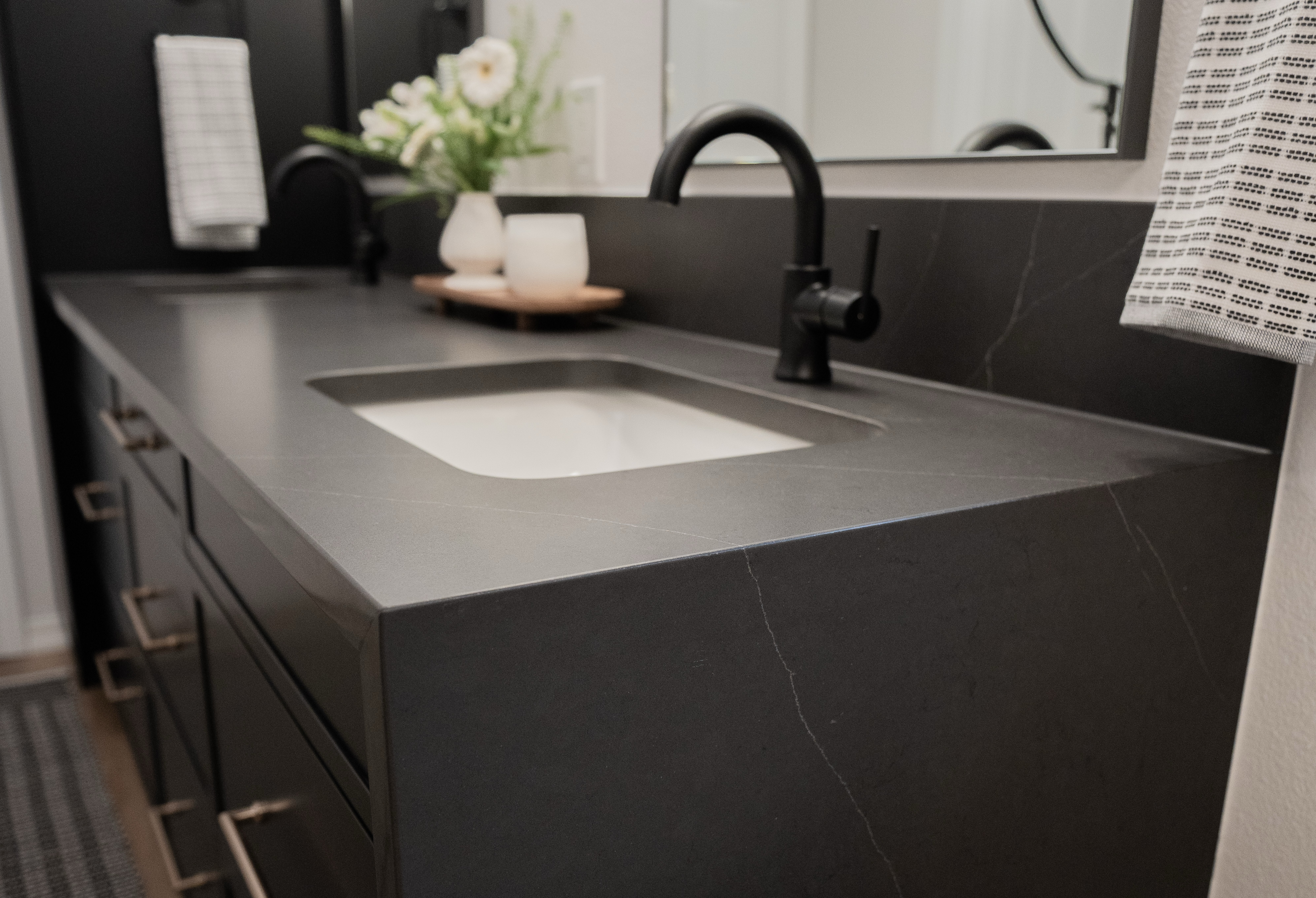
"Eased" does not denote one fixed geometry. It describes a range of small round-overs machined into an otherwise square edge, and the specific dimension you select alters how the edge reads visually without meaningfully affecting overall fabrication cost.
- 1/16 inch. Barely perceptible to the eye. Its primary function is knocking the sharpness off a true square edge and reducing the risk of a chipped corner during fabrication and shipping.
- 1/8 inch. The most common specification we receive from clients. Comfortable enough under a hand while still reading as a clean, geometric line from a few feet away.
- 1/4 inch. Noticeably rounded without approaching a full bullnose profile, a reasonable intermediate step for anyone wanting a softer edge without the additional cost of true bullnose fabrication.
All three configurations fall under the same fabrication baseline. Selecting a larger round-over within this range does not meaningfully affect your quote, since the labor differential between a 1/16 inch and a 1/4 inch radius remains negligible for an experienced fabricator. The determination ultimately hinges on how soft you want the edge to look and feel, rather than on budget considerations.
Why We Recommend Eased or Square Edges for Most Seattle Kitchens
Our recommendation rests primarily on how the kitchen looks and functions day to day, with cost and upkeep serving as secondary considerations. Appearance takes precedence deliberately, since it is what you encounter every time you enter the room.
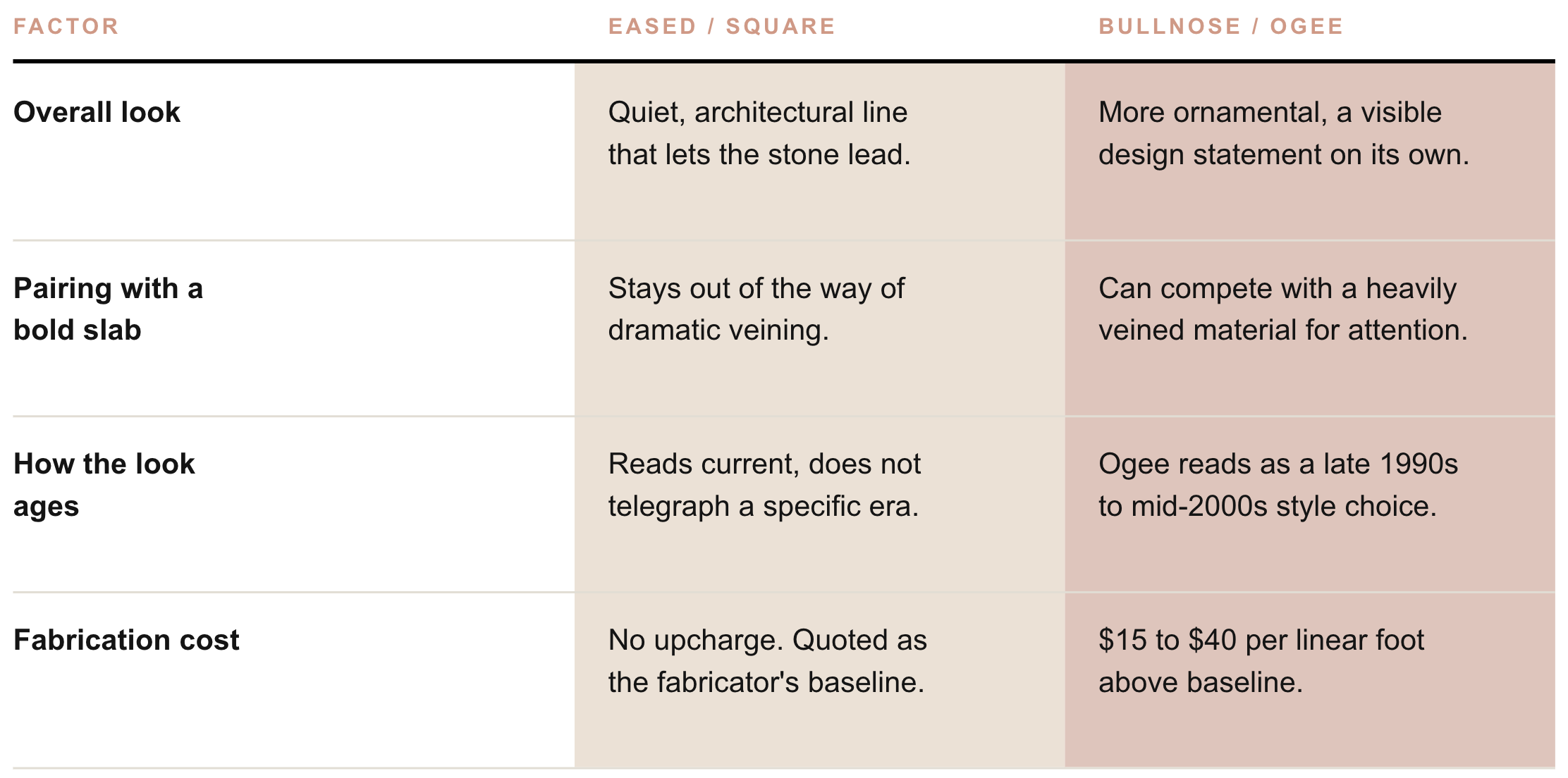
Look. Eased and square edges read as clean, architectural, and current, and they do not compete with the material for visual attention. If you have chosen a slab with genuine character, whether strong veining, a dramatic pattern, or a distinctive color, a quiet edge allows that material to remain the feature rather than sharing the spotlight with an ornate edge shape. A heavier profile like ogee constitutes a decorative statement in its own right, which can work beautifully in the appropriate kitchen, but it also means the edge is asserting its own presence rather than framing the stone.
How the look ages. Heavier, more ornate profiles like ogee proliferated throughout kitchen remodels from the late 1990s through the mid 2000s, and that aesthetic now reads as dated to most buyers and homeowners alike. Eased and square edges do not carry that risk, since their inherent simplicity allows them to sit comfortably within a kitchen for decades without announcing a particular era.
Cost, as a secondary factor. A square or eased edge is what nearly every fabricator quotes at baseline, since it requires the least machine time and no hand finishing. Decorative profiles like ogee, waterfall, and mitered work commonly add $15 to $40 per linear foot above that baseline, and a waterfall island typically adds another $1,000 to $3,000 depending on material thickness and drop height. For clients who want a decorative profile as a deliberate design choice, that cost is simply part of the decision. It should not be the deciding factor either way.
Durability, briefly. This factor matters considerably less than most people assume. With harder materials like granite or quartz, all of these profiles hold up adequately under ordinary daily use. It becomes a legitimate consideration with a softer material like marble, where a rounded edge resists chipping somewhat better than a sharp corner, though for the majority of our clients working with granite or quartz, this consideration barely influences the decision relative to how the edge actually looks.
There exists a fourth reason we rarely articulate up front, and it deserves plain statement. A plain edge is simply more forgiving to execute correctly. Fabrication error on a square or eased edge is nearly impossible, since no hand-shaping step exists where a technician's skill level can introduce inconsistency. On an ogee or a tight bullnose radius, a rushed or less experienced fabricator can leave visible tool marks or an uneven curve. We have observed both outcomes on other contractors' projects, and it constitutes one additional quiet argument for the plain edge, layered on top of the aesthetic, longevity, and cost factors already addressed above.
What Are the Alternative Edge Profiles, and When Might They Make Sense?
The other common countertop edge profiles exist for real reasons. We are not suggesting they are wrong choices, and we are simply explaining why they are not our default recommendation.
A full bullnose rounds the entire edge thickness into a continuous semicircle, eliminating the corner altogether. A demi-bullnose rounds only the upper portion and keeps a flat lower face. Both read as softer and more tactile than a square edge, which some clients want purely as a style preference, and it happens to pair well with a softer material like marble too.
A bevel is a 45-degree chamfer along the top corner, typically cut a quarter inch to a half inch deep, adding visible dimension without much extra machining. That said, it substitutes one square corner for two shallower ones, a genuinely mixed outcome, and it works best purely as a style choice rather than a functional upgrade.
An ogee is a compound S-curve. It is the most decorative common profile and the most labor-intensive to fabricate, since the cove has to be hand-polished into a curve no automated equipment reaches evenly, and it also takes more effort to clean, since that recessed cove collects grease and crumbs that a cloth simply bridges over rather than reaching into. We recommend it only when a client has a specific, considered reason for wanting that look, not as a default.
A waterfall or mitered edge continues the countertop material down the side of an island to the floor, or joins two slab pieces to fake a thicker countertop. These are less a profile choice than a design statement, and they make the most sense on a single island in an entertaining-focused kitchen, paired with a plain eased edge on the perimeter runs where nobody is paying close attention to the detail.

How This Plays Out Across a Seattle Kitchen Remodel
Seattle's kitchens vary widely. Compact galley layouts in older Capitol Hill and Ballard homes look nothing like the open-concept islands common in newer Queen Anne and Magnolia builds, yet our recommendation holds across nearly all of them. Census estimates put the Seattle metro area at 2.5 persons per household, and household composition varies enough across neighborhoods that we do not lean on demographic assumptions to make this call.
What we lean on instead is a simple pattern we see repeatedly on site: in a tight galley kitchen, every linear foot of counter sits within arm's reach of the aisle, and a plainer edge just looks and feels cleaner in that kind of space. In an open kitchen with a large island, the decision matters more at the seating overhang than anywhere else. That is exactly why a waterfall or bullnose treatment on the island alone, paired with eased edges everywhere else, tends to be the more sensible split for a full kitchen.
A few situations where we would recommend stepping up from the default:
- You want a softer, more tactile edge in the design. Demi-bullnose or full bullnose is a legitimate style choice on its own, independent of any practical need.
- You chose a softer material like marble. Bullnose or demi-bullnose is worth considering here, since the rounder profile resists chipping somewhat better than a sharp corner, though this is a secondary point rather than the main reason to choose it.
- You are building a single showpiece island for entertaining. A waterfall or mitered edge on that one surface, with eased edges elsewhere, gets you the visual statement without paying the premium across the whole kitchen.
- A contractor's bid specifies ogee or another elaborate profile without asking what look you actually want. That is worth a conversation before you sign. It may still be the right call for your kitchen, but it should be a deliberate style choice.
Outside of those situations, our honest recommendation is the plain edge. We will tell you that directly in a consultation rather than upselling a fancier profile by default, since a client who trusts our advice on the small decisions is more likely to trust us on the larger ones too.
The Natural Stone Institute maintains the standardized profile nomenclature US fabrication shops reference, and its Dimension Stone Design Manual chapter covering stone counter and lavatory tops documents these profiles alongside overhang capacity, seam placement, and sink mounting, if you want the underlying industry terminology beyond what we cover here.
Get a Straight Answer on Your Countertop Edge Profile
If you are planning a kitchen remodel in Seattle and weighing edge profile options, or comparing bids where one contractor specified something more elaborate than another, we are happy to give you a direct recommendation rather than a menu of options with no guidance. In most cases, that recommendation will be the plain edge, and we will tell you why.
Brutsky Builds serves homeowners throughout Seattle, Bellevue, Kirkland, and the surrounding area on kitchen projects and whole-home remodeling in Seattle, covering material sourcing, fabrication coordination, and installation supervision. Our work holds a 5.0 rating across more than 100 reviews on Google, Houzz, and Yelp combined.
We are registered with Washington L&I (#BRUTSBL783ON), bonded at $30,000, insured at $1,000,000 in general liability, and every kitchen remodel carries a 1-year warranty covering our workmanship.


.svg)
.svg%20fill.svg)


.jpg)



.webp)
.webp)
.webp)

.svg)